The History of Halloween
Introduction
We are all familiar with the rituals of Halloween - pumpkin carving, costume wearing, trick-or-treating, and of course, watching scary movies. But where did this spooky holiday come from, and how did it become what it is today? Let’s take a look!
Origins of Halloween
Halloween originally began with Celtic Pagans and the festival of Samhain, in which people would wear costumes and light bonfires to ward off evil spirits. Samhain (pronounced Sah-win) was a harvest festival taking place at the end of summer. Pagans believed that on this day, the eve of their new year, the veil between the worlds of the living and the dead was thinner - hence why they sought to ward off spirits.
In the eighth century, Pope Gregory III designated November 1st as the day to honor the saints, called All Saints Day. This holiday quickly adopted some of the traditions of Samhain, and the evening before came to be known as All Hallows Eve, and later, Halloween. This holiday also perpetrated the idea of the living coming into contact with spirits, hence why Halloween is still associated with ghosts and spooks.
Traditions
Let’s take a look at the three most well-known Halloween traditions: dressing up, carving pumpkins, and trick-or-treating. Donning costumes is a tradition traced back to the beginnings of Samhain, in which people would put on masks to avoid the attention of spirits - the idea was that if they dressed up, the spirits would not mistake them for fellow specters.
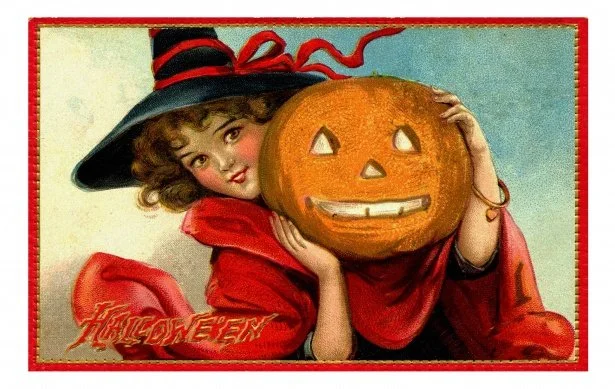
Carving pumpkins originated in Ireland, though they originally used turnips. It is allegedly based on a legend about a man named Stingy Jack, who trapped the Devil and let him go only on the condition that Jack would not go to Hell when he died. However, when he died, he discovered that Heaven did not want his soul either, and he was forced to wander the Earth as a ghost for all eternity. The Devil gave Jack a carved out turnip with a candle in it as a lantern, hence the tradition. People later began carving scary faces into their turnips (and pumpkins) to frighten away evil spirits.
There is some contention as to exactly where the tradition of trick-or-treating came from, but it is widely accepted that going door-to-door for treats has long been a part of Halloween festivities. The treats children received were not always candy, but included anything from nuts to fruit to coins to toys. Candy rose to dominate the trick-or-treating industry in the 1970s, when parents began fearing anything unwrapped. As for trick-or-treating, there are three theories: first, that it stemmed from the Celtic tradition of leaving food offerings out to appease spirits during Samhain. Over time, people began to dress up as spirits in order to get away with taking some of the food for themselves. The second theory is that it stems from the Scottish practice of “guising”, in which children and poor adults would go house to house and beg for food handouts in exchange for prayers for the departed. Eventually, guisers dropped the prayers in favor of songs, jokes, and other “tricks”. The third theory is that trick-or-treating in America comes from a German-American Christmas tradition called “belsnickeling”, in which children would dress up and go from house to house to see which neighbors could discern their identities. Sometimes, children would receive sweets as a reward if no one could guess.
Conclusion
Halloween is a widely celebrated holiday with many variations on its traditions and practices. Whether your Halloween consists of handing out candy, attending or hosting a party, playing a spooky RPG with friends, or watching Rocky Horror Picture Show for the fifth year in a row, it’s a time for fun all around! Now that you know a bit more about it, we hope your enjoyment of this excellent holiday grows even more! We leave you with a final reminder to compost your pumpkins!
Sources:
Thomas, Heather. “The Origins of Halloween Traditions.” The Library of Congress, 26 Oct. 2021, https://blogs.loc.gov/headlinesandheroes/2021/10/the-origins-of-halloween-traditions/.
History.com Editors. “Halloween: Origins, Meaning & Traditions.” HISTORY, 18 Nov. 2009, https://www.history.com/topics/halloween/history-of-halloween.